
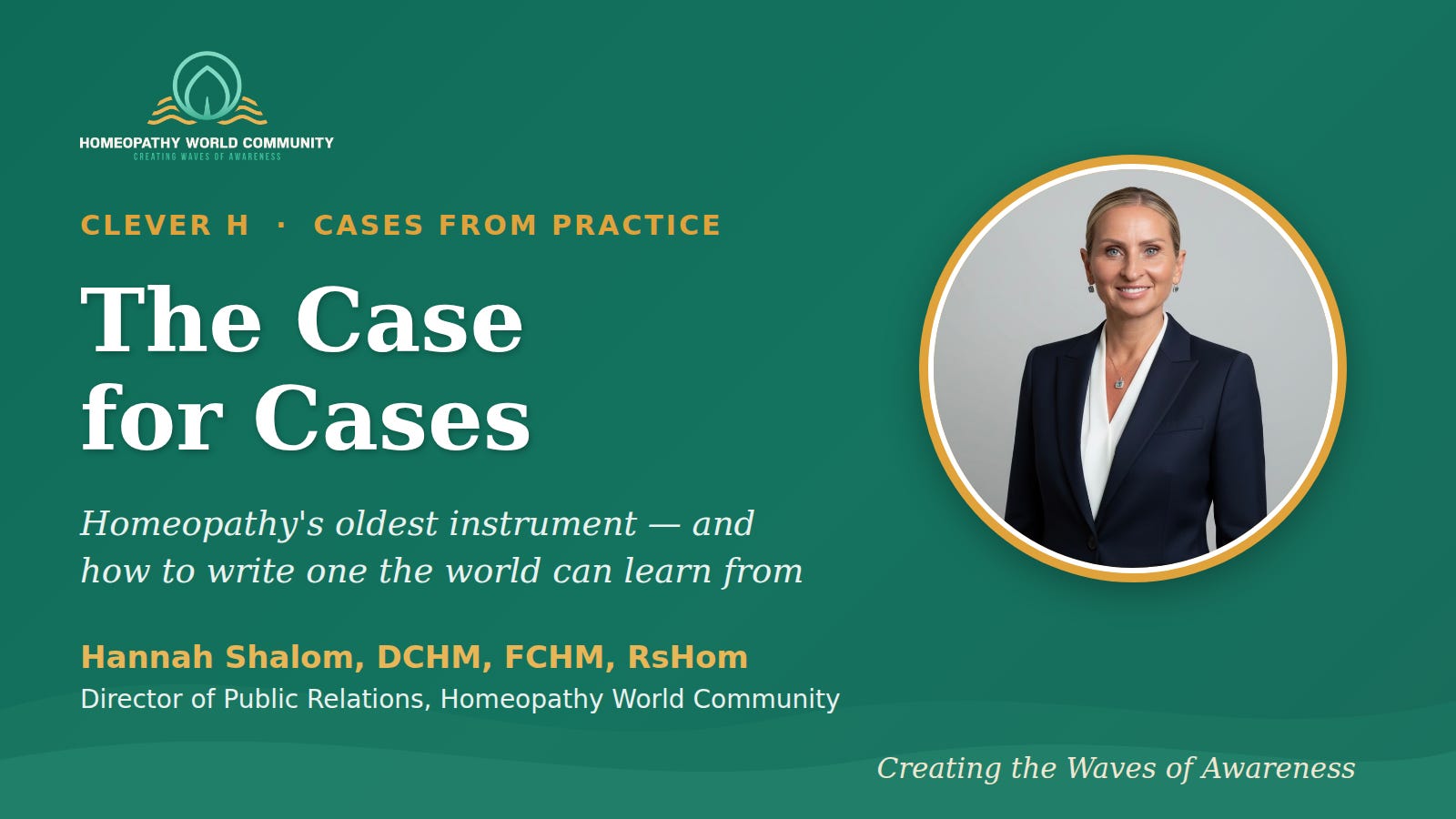
Ask a homeopath what convinced them, and you will almost never hear about a meta-analysis. You will hear a case. The child whose recurrent otitis stopped after Pulsatilla. The grief that finally moved after Natrum muriaticum. The case is how our knowledge was built, how it is taught, and — for most of us — how conviction arrived. With this article we open the second pillar of Clever H, Cases from Practice, and I want to begin it by making an argument that may sound paradoxical: the humble case report, so often dismissed as “mere anecdote,” is at once homeopathy’s oldest instrument and one of its most rigorously modernized. The difference between an anecdote and a contribution to knowledge is not the case itself. It is how the case is recorded, written, and shared.
Hahnemann, the record-keeper
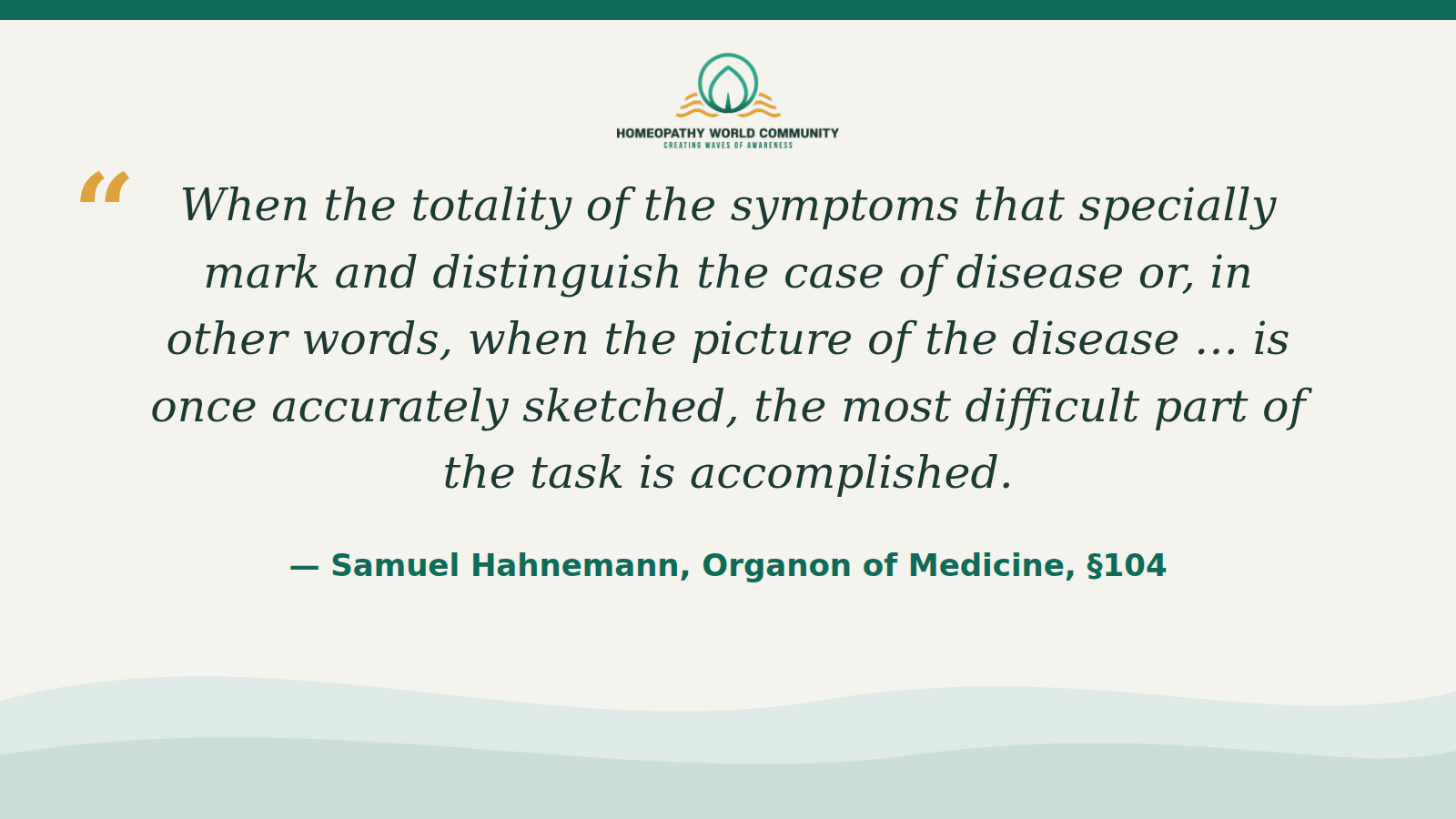
Homeopathy is unusual among the healing arts in that its founder was a compulsive documentarian. Hahnemann’s surviving case journals — the Krankenjournale, kept continuously across his decades of practice in Germany and Paris — record thousands of consultations in his own hand: the patient’s words, the remedy, the potency, the follow-up. He did not consider this clerical work. He legislated for it in the Organon. In §104, having described the individualizing examination, he tells us that once the totality of symptoms “is once accurately sketched, the most difficult part of the task is accomplished” — the written picture is the case, the physician’s permanent possession, “to be perused again and again.” [1]
The journals themselves reward study. Hahnemann noted the patients’ own expressions, tracked repeat consultations across months, and revised his assessments in the light of outcomes — the same loop of observation, intervention and follow-up that any modern case structure formalizes. Read that against the reality of much modern practice — abbreviations on an index card, a remedy name in a margin — and Hahnemann’s standard is humbling. He understood something that evidence-based medicine took another two centuries to formalize: an observation that is not recorded in full is an observation the profession loses. The first discipline of the Cases from Practice pillar is therefore his: write it down, completely, at the time.
What a case can prove — and what it cannot
Let us be honest about the epistemology, because our credibility depends on it. A single case, however dramatic, cannot prove that a remedy works. Improvement may be the natural course of the disease, regression to the mean, the effect of the consultation itself, or of something else the patient changed. Critics are right about this, and we gain nothing by pretending otherwise.
But it does not follow that cases are worthless — and here the mainstream literature is on our side. In a classic paper in the Annals of Internal Medicine, the Leiden epidemiologist Jan Vandenbroucke mounted a defense of the case report that every homeopath should know. Case reports and case series, he argued, “have a high sensitivity for detecting novelty and therefore remain one of the cornerstones of medical progress”: they permit the discovery of new diseases and unexpected effects, they illuminate mechanisms, and they are irreplaceable in medical education. [2] Penicillin’s promise, thalidomide’s danger, and AIDS itself all announced themselves to medicine as case reports.
The case, in other words, is where hypotheses are born and where clinical judgement is trained. What it requires — in homeopathy exactly as in oncology — is that it be reported well enough for others to evaluate, and held with appropriate modesty about what it shows.
The quiet revolution: reporting standards
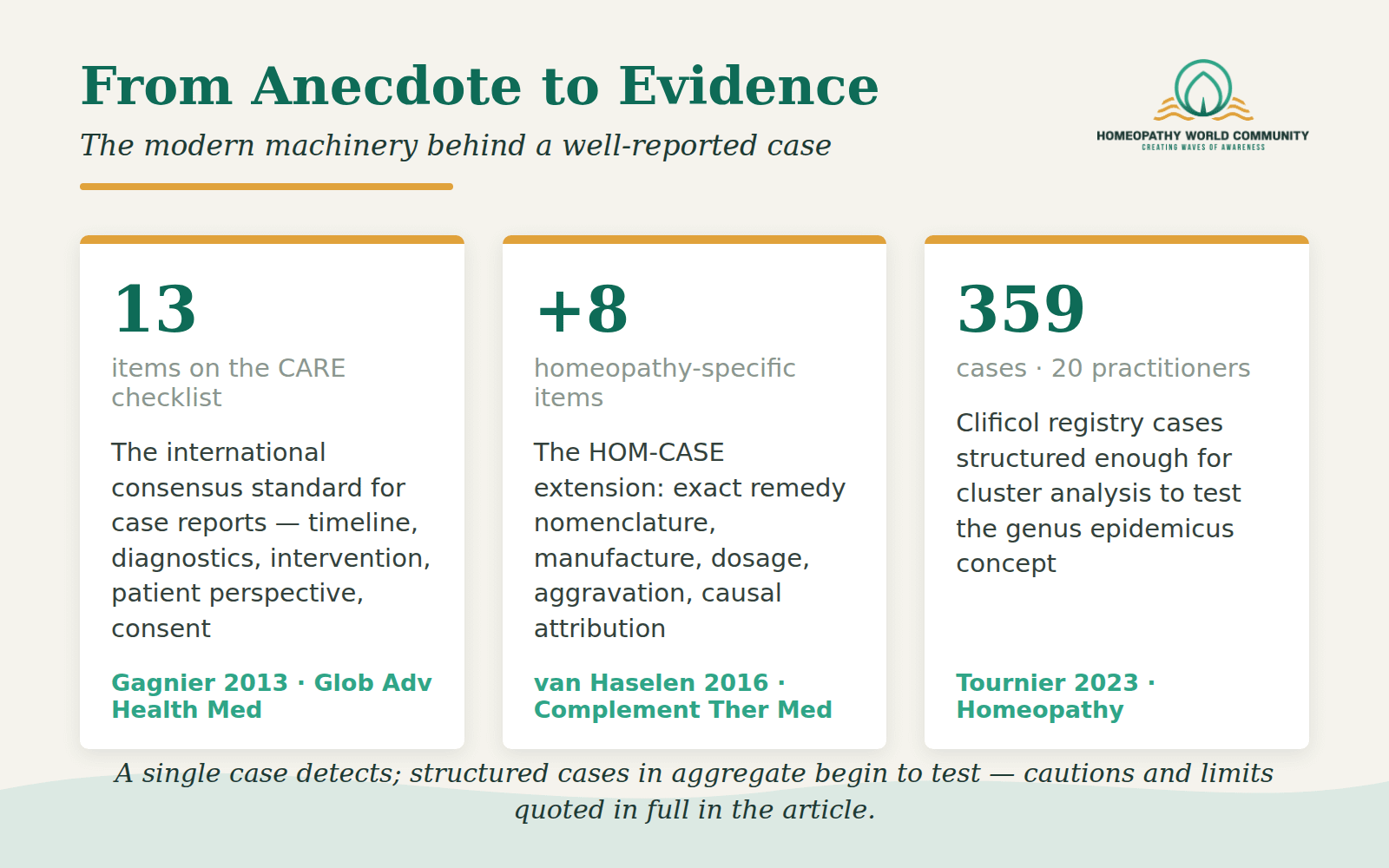
Here is the part of the story too few practitioners know. In 2013, an international consensus group — including Douglas Altman and David Moher, two of the most respected methodologists in evidence-based medicine — published the CARE guidelines (for CAse REport): a 13-item checklist specifying what a publishable case must contain, from the patient’s presenting information and clinical timeline through diagnostic assessment, intervention, follow-up, and — notably — the patient’s own perspective and informed consent. [3] Hundreds of medical journals now use it.
And homeopathy, to its credit, did not wait to be dragged along. In 2016, Robbert van Haselen convened a Delphi panel of nineteen homeopathic experts from Europe, the USA and India and published HOM-CASE, a formal extension of CARE for homeopathic case reports. [4] It adds eight homeopathy-specific core items: the clinical history from a homeopathic perspective; the type of homeopathy practised; precise description of the medication — nomenclature, manufacture, galenic form and dosage; objective outcome evidence where available; any homeopathic aggravation; and an explicit assessment of whether the changes can be attributed to the treatment.
Every item on that list answers a question a skeptical reader is entitled to ask. Which remedy exactly, from which pharmacy, in which potency and posology? What changed that can be verified — a lab value, a validated score, a photograph? Did anything worsen first? Could something else explain the result? A case written to CARE + HOM-CASE standard is no longer an anecdote. It is a document another clinician, or a researcher, can actually use.
Grading our own certainty
The most searching of those questions — was it really the remedy? — now has a formal instrument of its own. Building on the Naranjo algorithm used in pharmacology for adverse-drug reactions, homeopathic researchers developed the Modified Naranjo Criteria for Homeopathy, a ten-domain inventory for scoring the likelihood that a clinical outcome is causally attributable to the homeopathic intervention: Did improvement follow the remedy in a plausible time course? Was it clinically significant? Does the direction of change fit what we would expect? Are alternative explanations accounted for?
In 2020, a validation study assessed the tool across sixty case reports selected precisely because they met CARE and HOM-CASE criteria, and found it reliable and valid in nearly every domain — the instrument now carries the acronym MONARCH. [5] Think about what that means for the ordinary practitioner: after the follow-ups, you can sit down with a one-page inventory and honestly grade your own case — and publish that grade with it. A profession willing to score its own certainty, case by case, is a profession that has stopped being afraid of the question.
From one case to many: the registry era
The final act in the case’s modernization is aggregation. A single case detects; many structured cases, pooled, begin to test. This is the idea behind Clificol, an international online registry into which practitioners enter structured clinical cases. During the first wave of the pandemic, twenty practitioners contributed 359 cases of confirmed or suspected COVID-19 from the Chinese population — 766 consultations — and because the cases were recorded in a standardized 150-item format, researchers could do something never before possible in our literature: run principal-component and cluster analysis on the presenting symptoms to test the old doctrine of the genus epidemicus. The data revealed not one epidemic remedy picture but at least two distinct symptom clusters, each mapping onto a different predominant prescription. [6] A two-hundred-year-old concept, refined by statistics — because practitioners wrote their cases down in a shared structure.
The same logic powers prognostic factor research, which we met in the first article of this series: likelihood ratios that sharpen our repertories can only be computed from large sets of well-documented cases and outcomes. [7] Every rigorous case you record is, potentially, a data point in the materia medica of the next generation.
What Cases from Practice will publish
Before the invitation, a word about habit — because a publishable case is not written after the fact; it is recorded into existence, consultation by consultation. Four practices make the difference. Keep the patient’s exact words, in quotation marks, rather than your translation of them: “it feels like a stone lying there” is repertorizable and quotable; “epigastric heaviness” is neither. Date everything, so the timeline CARE asks for reconstructs itself. Anchor the case to something measurable from the first visit — a validated score, a lab value, a photographed skin lesion (with consent), or simply the patient’s own 0–10 rating of their chief complaints — so that “better” at follow-up has a number behind it. And write the follow-up notes with the same care as the intake, including the inconvenient details: the aggravation, the interrupted course, the second remedy you wish you had not given. Those are precisely the passages that make a case trustworthy to a critical reader — and useful to a colleague.
So this pillar has a standard, and I want to state it plainly, because it is also an invitation.
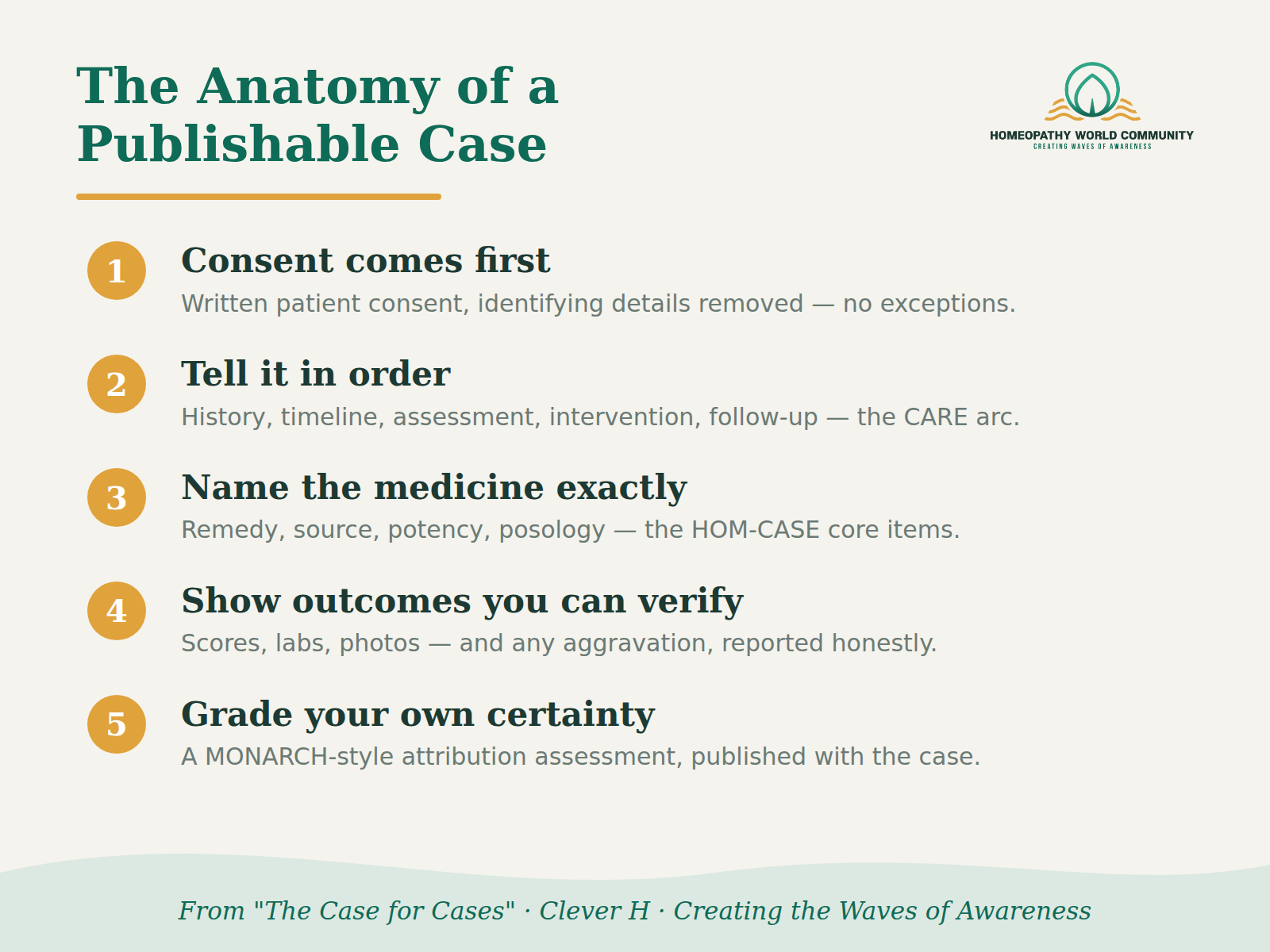
We are looking for real cases from real practice — acute or chronic, spectacular or instructive precisely because they are ordinary. Cures are welcome; so are partial results and honest failures, which often teach more. Every case we publish will have the patient’s written consent and identifying details removed. Every case will follow the CARE arc — history, timeline, assessment, intervention, follow-up — with the HOM-CASE specifics: the exact remedy, source, potency and posology, objective outcomes where they exist, any aggravation, and the author’s own MONARCH-style assessment of attribution. And every case will end the way the best case presentations always have: with what the author would do differently now.
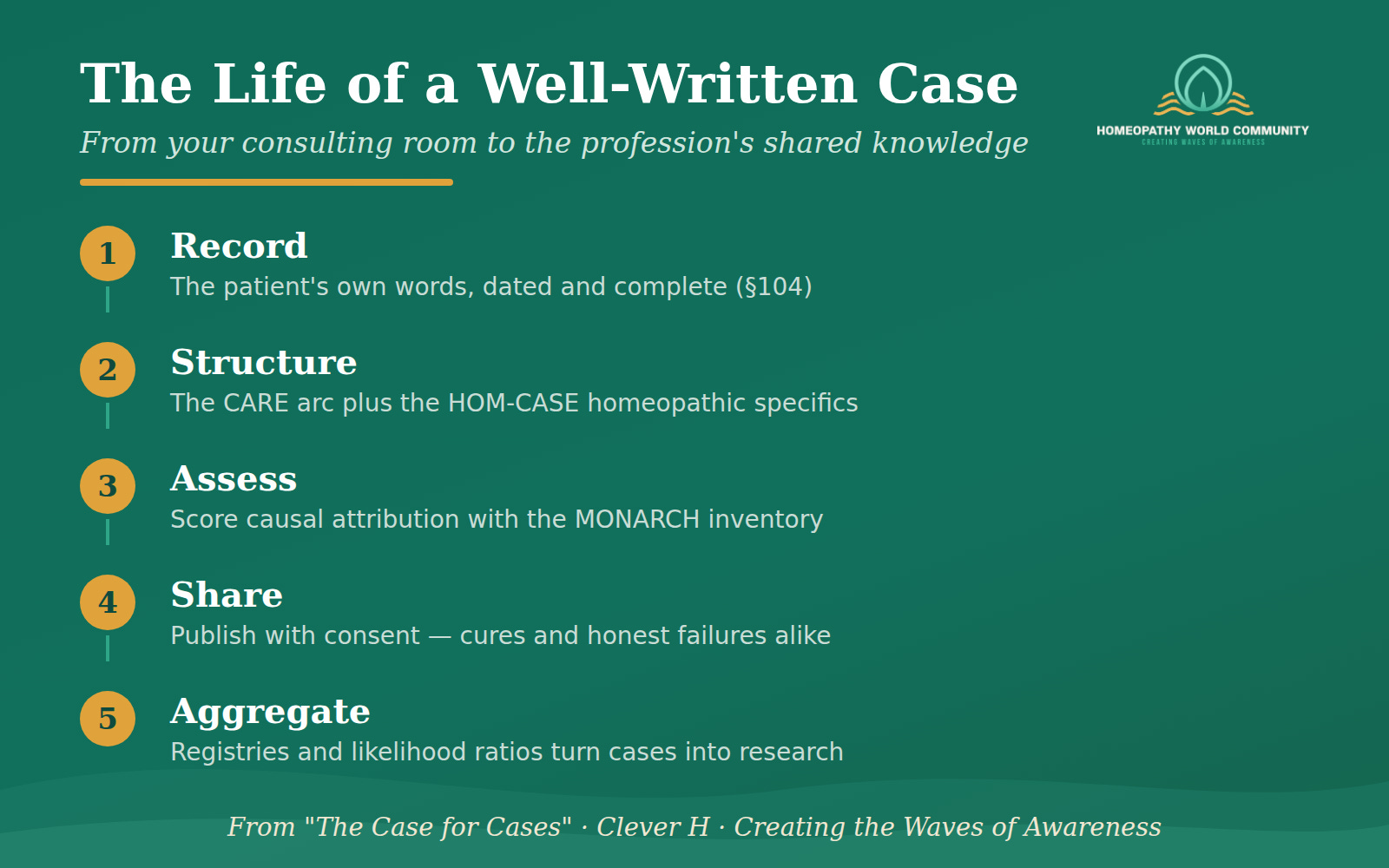
If you practise, you have such a case in your files. Clever H will help you shape it — our submission process includes editorial support, and each published article carries its own author contract. The casebook Hahnemann kept alone in Torgau is now something we keep together, in public, to a standard any physician can respect.
That is the case for cases. The first one is yours to send.
Hannah Shalom is a homeopath and functional medicine practitioner, PhD student, and Director of Public Relations at Homeopathy World Community. Submissions to Cases from Practice open with this issue — contact the Clever H editorial team via homeopathyworldcommunity.com.
Research & references (2–7 retrieved and verified via PubMed)
Hahnemann S. Organon of Medicine, 6th ed. (trans. Boericke), §104; see also §83–104.
Vandenbroucke JP. In defense of case reports and case series. Ann Intern Med. 2001;134(4):330–334. DOI: 10.7326/0003-4819-134-4-200102200-00017
Gagnier JJ, Kienle G, Altman DG, Moher D, Sox H, Riley D. The CARE guidelines. Glob Adv Health Med. 2013;2(5):38–43. DOI: 10.7453/gahmj.2013.008
van Haselen RA. Homeopathic clinical case reports: development of a supplement (HOM-CASE) to the CARE guideline. Complement Ther Med. 2016;25:78–85. DOI: 10.1016/j.ctim.2015.12.019
Lamba CD, Gupta VK, van Haselen R, Rutten L, et al. Evaluation of the Modified Naranjo Criteria… Homeopathy. 2020;109(4):191–197. DOI: 10.1055/s-0040-1701251
Tournier A, Fok Y, van Haselen R, To A. Searching for the genus epidemicus in Chinese patients: Clificol COVID-19 Clinical Case Registry. Homeopathy. 2023;112(1):30–39. DOI: 10.1055/s-0042-1750380
Mohanta A, Sardar N, Chakraborty K, et al. Estimation of the likelihood ratio of different symptoms for six homeopathic medicines. Homeopathy. 2025;114(3):183–194. DOI: 10.1055/s-0044-1787078
Hashtags
#HomeopathyWorldCommunity #CreatingWavesOfAwareness #HWCCommunity #Homeopathy #NaturalMedicine #HolisticHealth #CaseReport #ClinicalCases #HomeopathyResearch #Hahnemann #CleverH