

Every homeopath remembers the feeling. The case is taken, the repertory is open, three remedies are circling each other on the page — and a person is sitting across from you, waiting. The first prescription is the moment our whole discipline compresses into a single decision. It is also, I would argue, the most teachable and the most testable moment in homeopathy. Teachable, because Hahnemann left us an unusually precise manual for it. Testable, because modern research has begun to measure exactly the things he told us to care about.
This article walks through both: the art as Hahnemann framed it, and the data that now stands behind it.
What Hahnemann actually asked of us
In §3 of the Organon of Medicine, Hahnemann sets out the physician’s threefold knowledge: to perceive what is curable in disease, to understand what is curative in medicines, and to know how to adapt the one to the other. Notice the order. The first prescription does not begin with the remedy — it begins with perception.
That is why the case-taking instructions of §83–104 are not administrative preamble; they are the first prescription already underway. §83 demands “individualizing examination of a case of disease,” and §84 gives us the discipline most of us still struggle with: the patient speaks, the physician “is silent, allowing them to say all they have to say without interruption.” The famous “unprejudiced observer” of §6 is not a personality trait. It is a method — the deliberate refusal to translate the patient’s experience into our favourite remedy picture before the whole totality is on the table.
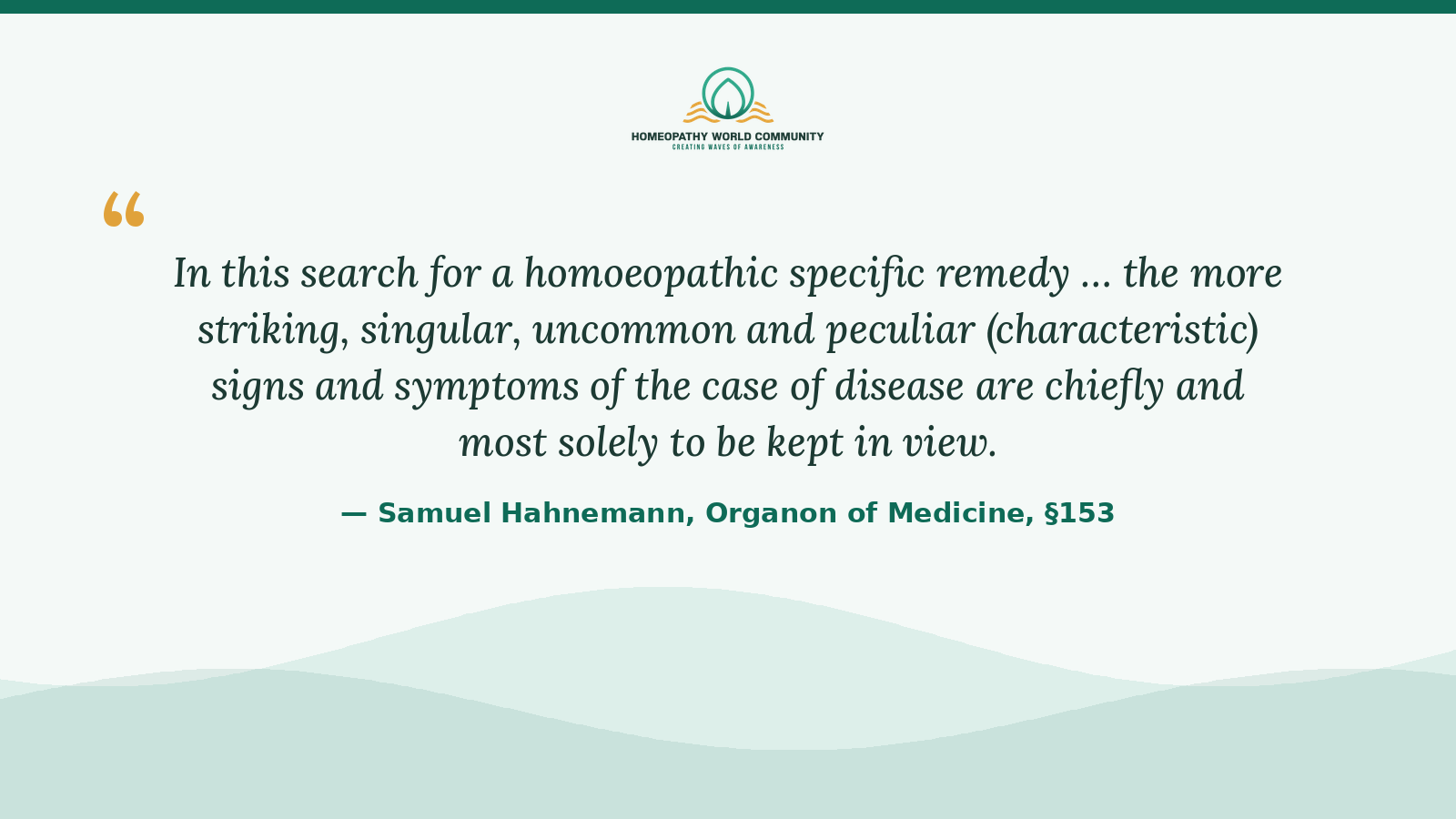
Then comes the sentence that turns a symptom list into a prescription. In §153, Hahnemann directs us to the “more striking, singular, uncommon and peculiar (characteristic) signs and symptoms” — the features that individualize this patient’s illness from every textbook version of it. Boenninghausen built his Therapeutic Pocketbook around that aphorism; Kent built his repertory and his hierarchy of symptoms on the same foundation. Every schema of case analysis we teach today — keynotes, essence, miasmatic weighting, the totality — is a strategy for answering the §153 question: what here is characteristic?
And once the remedy is chosen, Hahnemann’s restraint takes over: a single remedy at a time (§273), in the smallest dose capable of acting (§275–279), followed by observation rather than interference. The first prescription, done well, already contains the second — because the way we prescribe determines what we will be able to see at follow-up.
What the research now shows
For a long time we could only assert that individualization matters. Now we can point to data.
The clearest signal comes from Robert Mathie’s programme of systematic reviews, which did something earlier “global” homeopathy reviews never did: it separated individualized prescribing from standardized, off-the-shelf prescribing and assessed them independently.
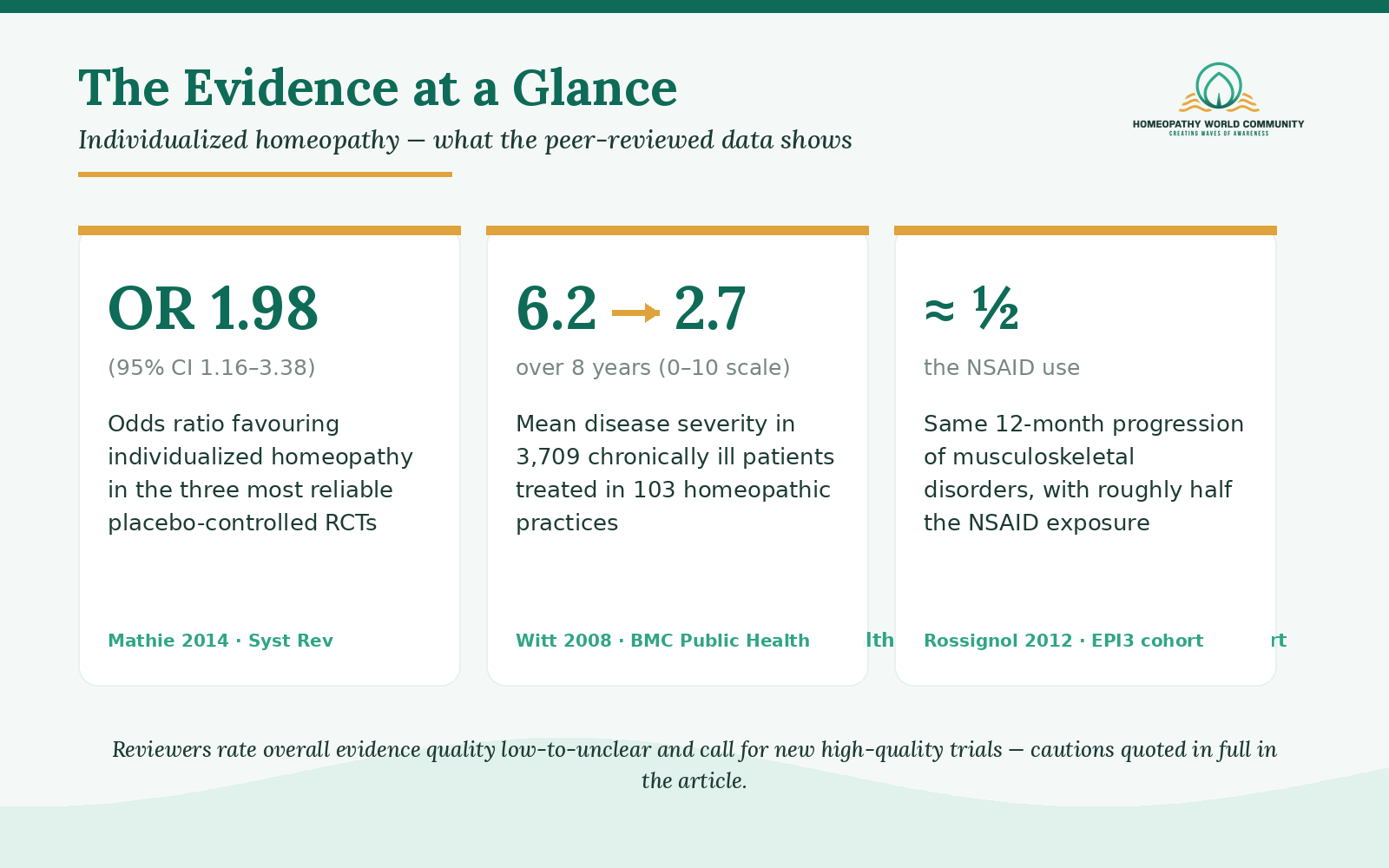
The 2014 meta-analysis of randomised placebo-controlled trials of individualized homeopathy — 32 trials across 24 conditions — found a pooled odds ratio of 1.53 (95% CI 1.22–1.91) favouring homeopathy, rising to 1.98 (95% CI 1.16–3.38) in the three trials rated as the most reliable evidence. [2] The authors were careful, and we should quote their caution as readily as their result: the overall quality of the evidence was low or unclear, and they called for new high-quality trials.
The companion 2017 meta-analysis of non-individualized homeopathy tells the other half of the story. Across 75 trials, the small pooled effect shrank after adjustment for publication bias, and in the subset of the most reliable trials it was no longer statistically significant. [3]
Read together, the two reviews carry a message every student preparing a first prescription should sit with: the evidence signal in homeopathy is strongest where the prescribing is most Hahnemannian. Skill in individualization is not decoration on top of the method. On present evidence, it may be the method’s active core.
Real-world outcome data points the same direction. The Charité-led cohort of 3,709 chronically ill patients in 103 primary-care practices in Germany and Switzerland — the largest long-term observational study of homeopathic care yet published — followed patients from their first consultation onward. Mean disease severity in adults fell from 6.2 to 2.7 on a 0–10 scale over eight years, and in children from 6.1 to 1.7, with substantial gains in quality of life. [4] An observational design cannot isolate the remedy’s contribution, but it tells us what patients actually experience downstream of a carefully taken first case. And the French EPI3 cohort adds a public-health dimension: patients with musculoskeletal complaints managed by physicians who prescribe homeopathy progressed just as well over twelve months while using roughly half the NSAIDs of conventionally managed patients — fewer drug-related risks, with no loss of therapeutic opportunity. [5]
The consultation is part of the prescription
One study in this literature deserves our honest attention rather than our defensiveness. Brien and colleagues’ 2011 trial in rheumatoid arthritis was designed to separate the effect of the homeopathic consultation from the homeopathic remedy. In that trial, patients who received the in-depth homeopathic consultation showed clinically relevant improvements — in disease activity, swollen joints, pain and mood — regardless of whether the medicine they then received was verum or placebo. [6]
Sceptics read that as a verdict against the remedy. I read it, first, as a finding Hahnemann would have recognized instantly: the individualizing examination is itself therapeutically active. The hour in which a person is finally heard in full — symptoms, history, fears, the whole narrative arc of their illness — is not a data-collection exercise that precedes treatment. It is treatment. That is precisely why Hahnemann legislated for it so carefully in §83–104.
But intellectual honesty cuts both ways, and our profession is strongest when it says so plainly: a single 24-week exploratory trial in one pathology is a reason to study the question further, not to close it — and the consultation effect it demonstrates belongs to us, not against us. The practical lesson for the first prescription is unambiguous. The case-taking is not the paperwork before the medicine. It is the first act of the medicine.
Where data sharpens the art
The newest and, to my mind, most exciting development is research that improves the inputs to a first prescription: prognostic factor research using likelihood ratios, pioneered by the Dutch physician Lex Rutten.
The logic is Bayesian and beautifully simple. A symptom earns its place in the materia medica not because it appears in patients who received a remedy, but because it appears more often in patients who went on to do well with that remedy than in those who did well with others. A prospective study in Kolkata followed 1,954 patients over 21 months and calculated likelihood ratios for classic symptoms of six frequently prescribed medicines. Some of our inherited keynotes performed superbly — “dyspepsia from business anxiety” reached a positive likelihood ratio of 27.4, and “burning pain relieved by heat” 29.6 — strong quantitative confirmation of what the materia medica has claimed for generations. [7]
The same method also delivers correction. A parallel study of four textbook symptoms of Vinca minor in contact dermatitis found none of them clearly attributable to the remedy, concluding that its symptoms “are perhaps over-represented” in our literature. [8] That, too, is a gift. A repertory pruned and weighted by outcome data is a sharper instrument in the hands of the prescriber choosing among those three circling remedies — and it is exactly the kind of self-correcting scholarship Hahnemann, the relentless reviser of his own Organon, modelled for us across six editions.
Five questions before the remedy goes out the door
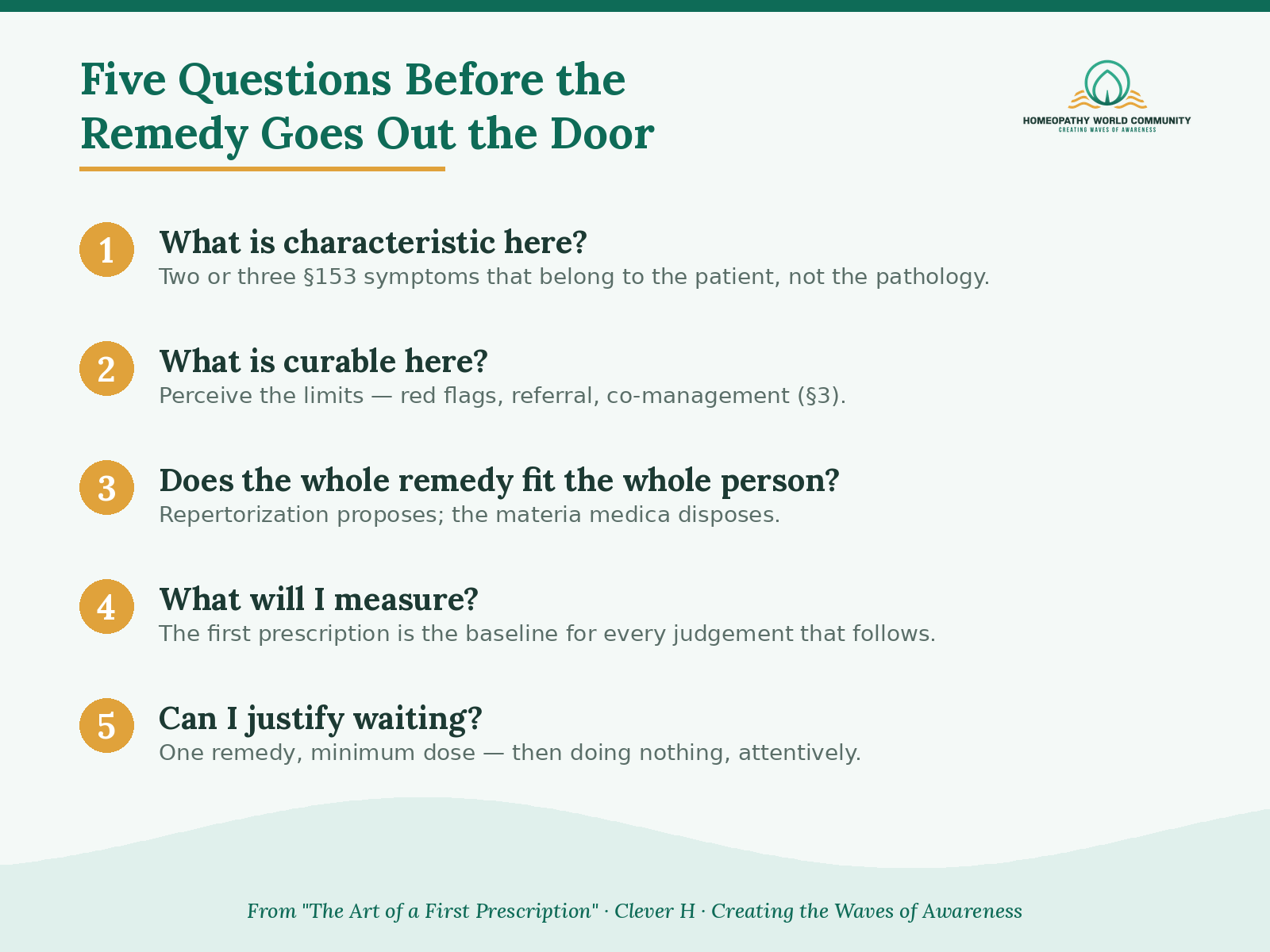
Method survives best as habit, so let me put the above into the form I use in practice and teaching. Before any first prescription leaves my desk, five questions get answered on paper.
What is characteristic here? If I cannot name two or three symptoms that are striking, singular, uncommon or peculiar in §153’s sense — symptoms belonging to the patient rather than the pathology — the case is not yet taken, and the honest next step is more listening, not more repertorization.
What is curable here? §3 asks us to perceive what is curable in disease. That includes recognizing what belongs to another practitioner: the red flags, the pathology needing referral or co-management. A first prescription made in ignorance of its limits is not bold; it is unfinished case analysis.
Does the whole remedy fit the whole person? Repertorization proposes; the materia medica disposes. The final comparison happens between the patient sitting in front of me and the full remedy portrait — not between a numerical score and its runner-up.
What will I measure? The first prescription is the baseline for every judgement that follows. Deciding in advance which complaints, on which scale, will define improvement is what makes the follow-up an assessment instead of an impression.
Can I justify waiting? One remedy, minimum dose, and then the hardest skill in the repertoire: doing nothing, attentively.
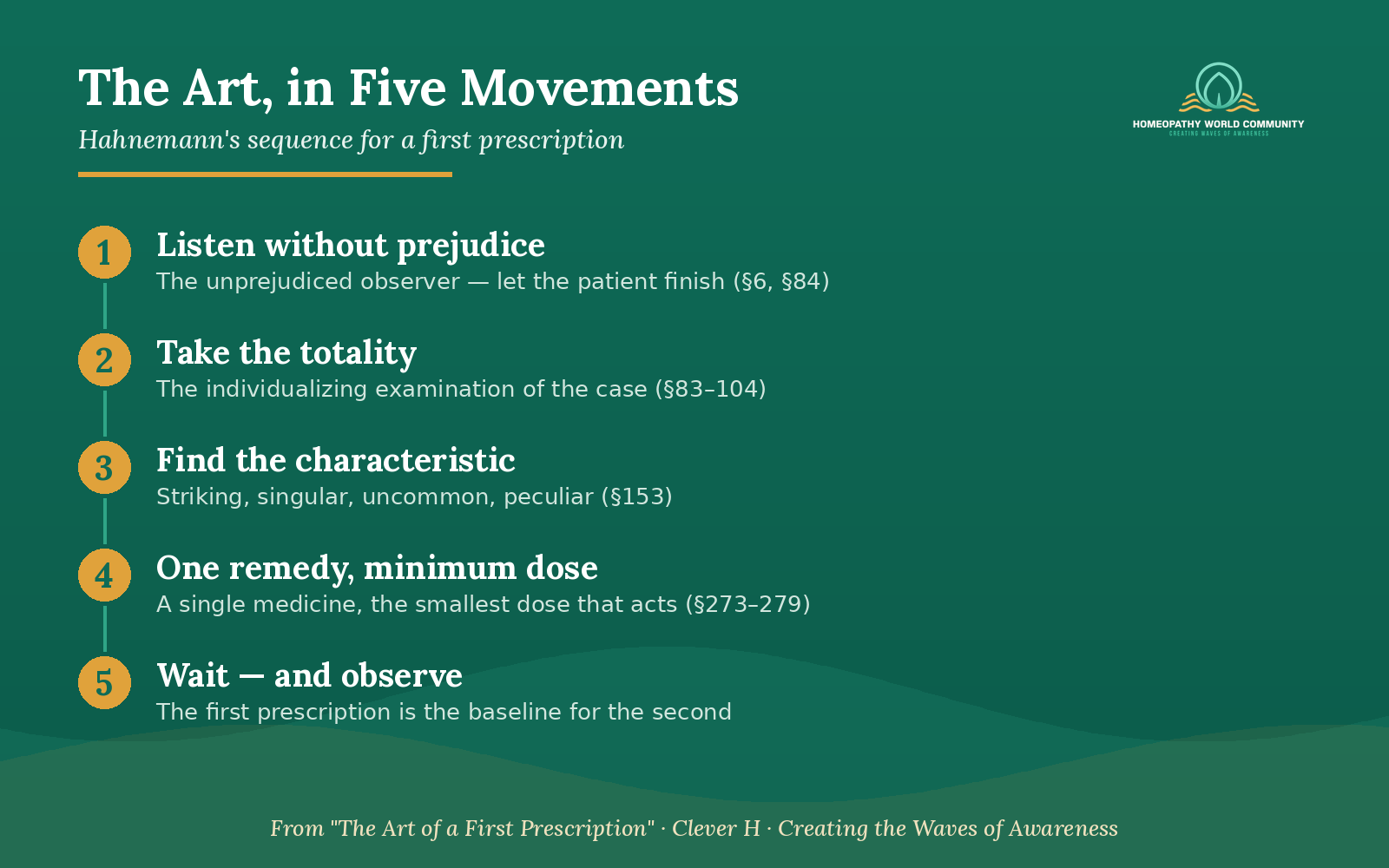
The art, then
So what is the art of a first prescription? It is not intuition floating free of method, and it is not mechanical repertorization either. It is a trained sequence Hahnemann described and research increasingly endorses:
Listen without prejudice, and let the patient finish. Take the totality, but weigh it — hunt for the §153 characteristic, the symptom that belongs to this person rather than to the diagnosis. Individualize, because that is where the evidence signal lives. Give one remedy, in the minimum dose, and then have the discipline to wait and observe, because the first prescription is also the baseline against which every subsequent decision will be read. And hold the whole process with the humility of the researcher: quote the cautions alongside the confidence intervals, welcome the studies that prune our materia medica as warmly as the ones that vindicate it.
Two hundred years on, the first prescription remains what it was in Hahnemann’s consulting room in Torgau: one person perceiving another with complete attention, and matching what they perceive to what medicines can do. The instruments have improved. The art is the same.
What was your most instructive first prescription — the one that taught you the most, whether it worked or not? Share the story (no identifying patient details, please) in the comments. The best teaching moments in our profession have always been shared ones.
Hannah Shalom is a homeopath and functional medicine practitioner, PhD student,
and Director of Public Relations at Homeopathy World Community.
References (research citations retrieved and verified via PubMed)
Hahnemann S. Organon of Medicine, 6th edition (trans. Boericke). §3, §6, §83–104, §153, §273, §275–279.
Mathie RT, et al. Randomised placebo-controlled trials of individualised homeopathic treatment: systematic review and meta-analysis. Syst Rev. 2014;3:142. DOI: 10.1186/2046-4053-3-142
Mathie RT, et al. Randomised, double-blind, placebo-controlled trials of non-individualised homeopathic treatment: systematic review and meta-analysis. Syst Rev. 2017;6:63. DOI: 10.1186/s13643-017-0445-3
Witt CM, et al. How healthy are chronically ill patients after eight years of homeopathic treatment? BMC Public Health. 2008;8:413. DOI: 10.1186/1471-2458-8-413
Rossignol M, et al. Impact of physician preferences for homeopathic or conventional medicines on patients with musculoskeletal disorders: the EPI3-MSD cohort. Pharmacoepidemiol Drug Saf. 2012;21(10):1093–1101. DOI: 10.1002/pds.3316
Brien S, et al. Homeopathy has clinical benefits in rheumatoid arthritis patients that are attributable to the consultation process but not the homeopathic remedy. Rheumatology (Oxford). 2011;50(6):1070–1082. DOI: 10.1093/rheumatology/keq234
Mohanta A, et al. Estimation of the likelihood ratio of different symptoms for six homeopathic medicines: prognostic factor research. Homeopathy. 2025;114(3):183–194. DOI: 10.1055/s-0044-1787078
Bagchi S, Nayak C, Rutten L, et al. Assessment of likelihood ratio for four contact dermatitis symptoms of Vinca minor. Homeopathy. 2018;107(3):209–217. DOI: 10.1055/s-0038-1654713